Operator-Led Offensive Security. Platform-Backed Risk Lifecycle.
Scope, Validate, Remediate, and Retest Security Findings in One System
1. Recommended Starting Point: Credential Evaluation
Fastest path to real value.
Most breaches start with credentials. The question isn’t whether you have a password policy — it’s whether your credentials actually withstand modern attack techniques.
Credential weakness isn’t just “bad passwords.”
Policies drift. Exceptions accumulate. Password reuse goes undetected. A configuration change quietly reintroduces risk. On paper, everything looks locked down. In practice, it isn’t.
Scapien performs a GPU-accelerated credential resilience assessment using a standardized, repeatable methodology aligned to real-world attacker tradecraft. We model modern cracking campaigns to measure actual resistance and identify the highest-leverage credential-driven access paths.
What this produces:
- Hard evidence of which accounts are vulnerable — and why
- Data to justify credential policy changes to leadership (proof, not opinion)
- A measurable baseline you can track over time
- A prioritized remediation queue so your team can act immediately
This is a short, high-signal engagement. Many customers use it as an entry point. Others run it independently as a standalone validation exercise.
2. Select Testing Scope
Available Scope Areas
Choose the areas that reflect your real environment. Start with one surface or combine multiple. Expand coverage over time as priorities and resource constraints dictate.
Authentication, business logic, injection flaws, session management, and API-specific attack surfaces.
Misconfigurations, privilege escalation paths, identity gaps, and exposed services across AWS, Azure, and GCP.
Internal and external network testing, segmentation validation, lateral movement analysis, and exploitable pathway validation.
Firmware analysis, communication protocols, device-level attack surfaces.
Highly specialized engagements with safety controls and strict scoping to avoid operational disruption.
Controlled physical assessments with defined rules of engagement and operational safeguards.
Each scope area is tested with real exploitation logic, not just scanning output. Findings are validated before they are prioritized.
3. Choose Engagement Depth (L1–L3)
Select the depth that aligns with your risk profile, timeline, and operational sensitivity. Depth is applied per system, application, environment slice, network segment, or site.
You can mix levels across your environment. For example, Level 2 for a production AWS workload, Level 1 for remote offices.
We do the heavy lift. Your team focuses on remediation.
Designed for speed, coverage, and repeatability.
Level 1 establishes a defensible baseline, reduces obvious exposure, and verifies that previously remediated security risks remain closed after drift and changes.
For lean security teams, Level 1 is often the cleanest entry point: low friction, fast signal, actionable output.
Level 2 answers the question leadership eventually asks: “How do we actually get breached?”
Instead of isolated findings, we validate plausible attack paths through your environment. Smart automation accelerates repeatable tasks and data analysis. Senior operators determine what is truly exploitable, what chains together, and what should be prioritized given your staffing and constraints.
This is the practical middle ground between baseline validation and bespoke red-team engagements.
Level 3 is for environments where uncertainty tolerance is low and consequences are high.
It is applied surgically to sensitive assets, business-critical systems, or OT environments where operational continuity and safety are non-negotiable.
Engagements are deeply tailored, tightly scoped, and conducted under strict rules of engagement.
Many organizations apply Level 3 to “crown jewel” assets while using Level 1 or Level 2 for broader coverage. The result is maximum realism where it matters most — without turning the entire program into an expensive science project.
4. What You Receive
You receive:
- Prioritized, validated exploitable findings
- Step-by-step remediation guidance
- Defined retest criteria
- Clear ownership and tracking
Your team knows exactly what to fix and how to prove it is closed. That reduces time-to-remediate because you are not debating severity or researching fixes.
Leadership receives an executive summary written for decision-makers: clear business impact, plain language, no noise.
All security risks are tracked inside iPAS:
- Owners
- Evidence
- Remediation status
- Retest outcomes
- Complete audit log from discovery through closure
No spreadsheet sprawl. No scattered inbox threads. No tool exports stitched together before an audit. One system. One view. Full lifecycle visibility.
5. How We Deliver, and Why It Matters
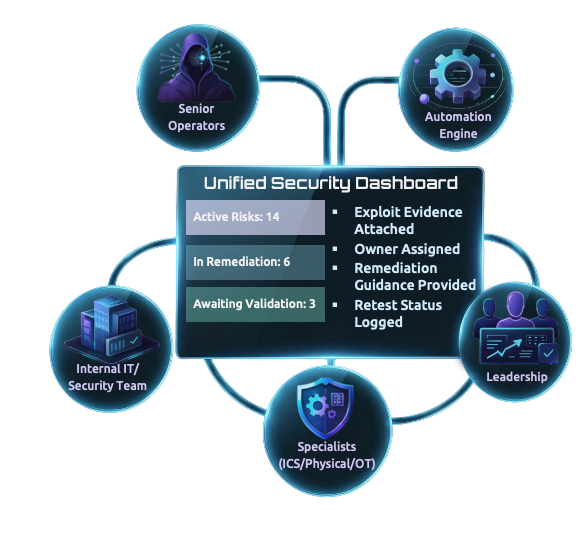
We Do Not Run Drive-By Penetration Tests
Most firms test, send a report, and leave. Your team is left to sort findings, assign owners, fix issues, and confirm closure.
Scapien combines senior security operators with automation.
Automation makes testing faster and more repeatable. Human judgment decides what is exploitable, what matters, and what fits your environment. Scope is based on your systems, resource limits, and real attacker paths.
You get one security risk dashboard, not another disconnected portal.
It brings findings, owners, remediation status, exploit evidence, and retest results into one record. Your team, outside partners, and Scapien operators work from the same system. Nothing gets lost. Leadership gets one clear view of risk.
We learn your architecture, critical systems, business needs, compliance pressure, and risk tolerance. Each engagement is shaped around your team and your priorities.
We do not flag issues and disappear. We help with practical remediation, clear closure criteria, and retesting that shows what is fixed and what remains open.
When needed, we bring in specialists, including ICS/OT and physical security experts, under controlled engagement models.
Submit the form. We’ll confirm scope, surfaces, and collaborate on the right engagement depth for your environment.